JillLebofsky may earn a commission if you buy through links on this page, at no extra cost to you. That does not change what we report.
Part of our VertiAid overview. Last checked November 6, 2026.
Does VertiAid really work? No published study has tested the VertiAid chewable, and no ingredient on its label is an established treatment for vertigo or dizziness. The Supplement Facts panel we read on November 6, 2026 lists 11 actives: six vitamins and minerals at set doses and a 227 mg proprietary blend of five more with no individual amounts[1].
That makes VertiAid a basic vitamin and mineral chewable sold with a balance story. The sections below separate what the vendor says from what the studies on each ingredient measured.
Does VertiAid work? The short answer
There is no evidence that VertiAid improves balance or stops dizzy spells, because nobody has published a trial of the product. The vendor says it "supports balance by maintaining the health of your inner ear's membrane"[2]. Neither the sales page nor the label names a study behind that line.
What can be concluded is narrower. Vitamin D3, riboflavin and B6 each sit at 100% of the Daily Value, the level of an ordinary multivitamin. Papaya, pineapple, marine collagen, eggshell membrane collagen and American ginseng share the 227 mg blend, so the dose of each is unknown[1].
Dizziness has many causes: BPPV, Meniere's disease, vestibular neuritis, blood pressure changes and medicines. Each one needs a clinician to find it. Our guide to the common causes of vertigo explains how they differ.
Which evidence levels should you not confuse?
Four levels of evidence often get blended on supplement sales pages. Only the top two would tell you whether VertiAid works, and VertiAid has neither.
Plausibility
A mechanism story: the sales page describes the inner ear membrane and says the formula "helps nourish and strengthen this key membrane"[2]. A story like this has not been tested in people. It is the weakest level.
Ingredient trials
Studies of one ingredient at its own dose. American ginseng was tested at 3 g a day for blood sugar[3]. Eggshell membrane was tested at 450 mg a day for knee joints[6]. Neither trial looked at balance, and VertiAid's whole blend weighs 227 mg.
Finished-product trial
A placebo-controlled trial of the VertiAid chewable with a dizziness or balance outcome. The label says "Clinically Researched Ingredients" but cites no trial of the product itself[1].
Replication
The same result from independent groups. The American ginseng glucose work comes from one research group, and the eggshell membrane trials are small and mostly brand-sponsored[3][6].
VertiAid claims vs what the evidence supports
Each VertiAid claim below has a reasonable reading, and each runs into a limit set by the label or the studies. We quote the vendor's wording and compare it with the evidence cards we keep on each ingredient.
| Vendor claim | Reasonable reading | Limitation |
|---|---|---|
| "Supports balance by maintaining the health of your inner ear's membrane" | A description of what the vendor hopes the formula does | No study of any label ingredient measured balance or inner ear function |
| "Optimally dosed proprietary blend" | Five of 11 actives share one 227 mg blend | Hidden doses cannot be compared with trial doses |
| "Clinically Researched Ingredients" (label) | Some ingredients have human studies | Those studies measured blood sugar, skin, joints or digestion |
| "Healthy Brain Function", "Focus & Concentration" (label) | Points at the B vitamins and ginseng | An American ginseng trial found no change in task performance[4] |
| "Scientifically proven, extra-strong ingredients" (sales FAQ) | Marketing language | The vitamins are at 100% of the Daily Value, a standard amount |
The sales page also lists only 9 ingredients and leaves out riboflavin and potassium, which are on the label[1][2].
Which ingredients matter most?
The ingredients with the most human research are American ginseng, marine collagen and eggshell membrane, and all three sit in the blend at unknown doses. Their trials also used different people and different goals from a buyer with dizzy spells.
- American ginseng: 3 g a day (1 g with each meal) in adults with or without type 2 diabetes[3]. The full VertiAid blend is under 8% of that amount.
- Marine collagen: skin trials pooled about 12 weeks of daily gram-level intake, mostly in women aged 20 to 70[5]. Synthesis studies used 15 g a day[9].
- Eggshell membrane: 450 mg a day for 12 weeks in knee osteoarthritis, about twice the whole blend. Without the authors' normalization, the main joint results were not significant[6].
- Papaya: a 20 ml liquid papaya preparation for 40 days in chronic indigestion, a different form from a dry powder[7].
- Pineapple powder: we found no human trials of whole fruit powder.
The dosed vitamins are clearer: 20 mcg vitamin D3, 1.3 mg riboflavin and 1.7 mg B6[1]. The vitamin D trials in our files tested bladder and prostate outcomes; one with 11,486 men at 2,000 IU a day found no lower odds of overactive bladder[8]. None tested dizziness. The full VertiAid ingredient list covers each one.
What results are realistic to expect?
Based on what the trials measured, a realistic outcome is no measurable change in dizziness. The ingredient studies ran 40 days to 12 weeks and tracked glucose, skin moisture, joint pain or indigestion[3][5][7].
Timing matters for refunds. The vendor's refund page advises using the product "for at least 3 months", but the money-back window is 60 days from delivery[10]. If you try it, decide before day 60. Our VertiAid dosage guide includes a simple symptom log, so you have dated notes rather than a memory of how you felt.
When should you see a doctor instead?
See a doctor before buying anything if dizziness is new, keeps coming back or changes, because the cause decides the fix. Vestibular exercises prescribed after a diagnosis are one option; our page on vertigo exercises shows common ones.
Call 911 right away if vertigo comes on suddenly with any of these:
- Weakness or numbness in the face, arm or leg
- Slurred speech or trouble finding words
- Face droop on one side
- Double vision or sudden loss of vision
- Fainting, chest pain or a racing heartbeat
Book a prompt appointment if: spells repeat over days, hearing drops in one ear, or dizziness started after a new medicine.
Evidence conclusion
VertiAid is untested as a product, and its ingredients are untested for vertigo. The table puts that in plain terms for the questions buyers ask most.
| Decision question | Current assessment |
|---|---|
| Has VertiAid itself been tested? | No published trial; none cited by the vendor |
| Is any label ingredient an established vertigo treatment? | No |
| Can doses be checked against studies? | Only for the six dosed vitamins and minerals; the 227 mg blend is hidden |
| Is there a refund if it does nothing? | 60 days from delivery; all bottles mailed back at your cost[10] |
If you still want to try it, get dizziness checked first and keep the 60-day date in your calendar.
Back to the VertiAid overview.
Frequently asked questions
Has VertiAid been tested in a clinical trial?
No published trial of the VertiAid chewable exists. The label says Clinically Researched Ingredients, but the studies behind those ingredients tested other products at their own doses, and none of them measured vertigo, dizziness or balance as an outcome.
Does VertiAid help with BPPV?
Nothing on the VertiAid label is an established treatment for BPPV or any other cause of vertigo. BPPV is one of several causes a clinician can identify in an office visit, so get the cause checked before spending $138 or more on a supplement.
How long does VertiAid take to work?
No study shows VertiAid working at any point. The vendor suggests at least 3 months of use, while the refund window closes 60 days after delivery. If you try it, judge your symptom log before day 60 so a refund is still possible.
Is VertiAid just a multivitamin?
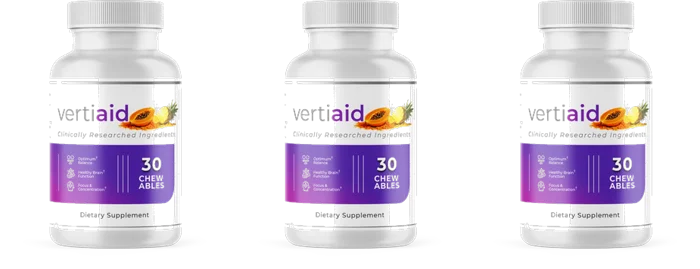
Mostly. Its dosed part is vitamin D3, riboflavin and B6 at 100% of the Daily Value, plus 20 mg calcium, 5 mg zinc and 30 mg potassium. The rest is a 227 mg blend of papaya, pineapple, two collagens and American ginseng.
Can VertiAid replace vertigo exercises?
No. VertiAid has no evidence for balance, while the right vertigo exercises depend on the cause a clinician finds. A supplement should never delay that visit, especially if dizziness is new or keeps coming back.
Sources
- VertiAid Supplement Facts label (V1). VertiAid vendor, read November 6, 2026.
- VertiAid sales page and FAQ. VertiAid vendor via BuyGoods, read November 6, 2026.
- Vuksan et al. 2000, American ginseng and postprandial glycemia in nondiabetic and type 2 diabetic subjects. PubMed, read November 6, 2026.
- White et al. 2020, acute American ginseng and working memory brain activity. PubMed, read November 6, 2026.
- de Miranda et al. 2021, oral collagen supplements and skin aging: meta-analysis. PubMed, read November 6, 2026.
- Hewlings et al. 2019, eggshell membrane in knee osteoarthritis: randomized trial. PubMed, read November 6, 2026.
- Muss et al. 2013, papaya preparation (Caricol) in digestive disorders. PubMed, read November 6, 2026.
- VITAL ancillary study, vitamin D3 and overactive bladder and urinary incontinence in men. PubMed, read November 6, 2026.
- Khatri et al. 2021, collagen peptide supplementation: systematic review. PubMed, read November 6, 2026.
- VertiAid refund policy. VertiAid vendor, read November 6, 2026.
This page is general information, not medical advice. Dietary supplements are not reviewed by the FDA for safety or effectiveness before they are sold and are not intended to diagnose, treat, cure or prevent any disease. Talk to your doctor before taking any supplement, especially if you are pregnant, nursing, take medication or have a health condition.