JillLebofsky may earn a commission if you buy through links on this page, at no extra cost to you. That does not change what we report.
Part of our VertiAid overview. Last checked November 6, 2026.
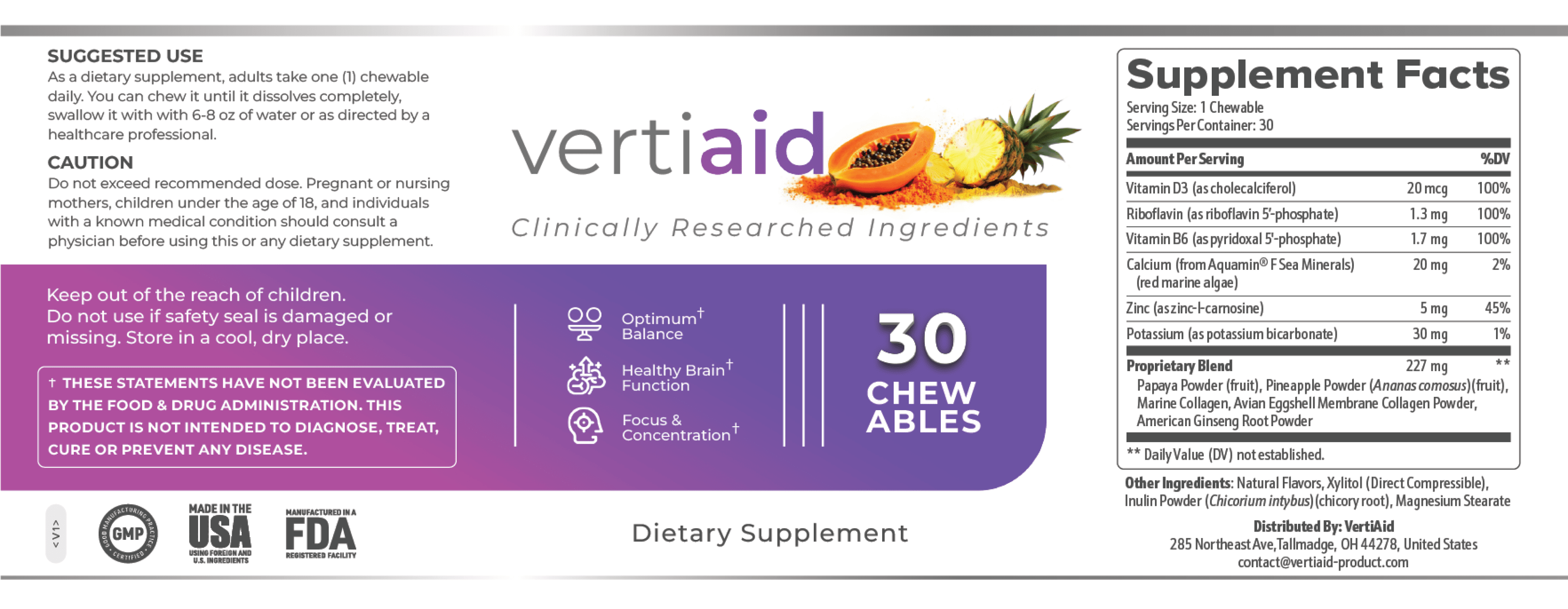
VertiAid ingredients are a short vitamin and mineral list plus a small herbal and collagen blend. The label we read on November 6, 2026 shows 11 actives in one chewable: six with stated doses and five inside a 227 mg proprietary blend with no individual amounts[1].
None of the 11 is an established treatment for vertigo or dizziness. Below is each one, what it is, and what human studies measured.
VertiAid ingredients at a glance
Six VertiAid ingredients have printed doses and five do not. The vitamins match 100% of the Daily Value; the minerals range from 1% to 45%[1]. The grade column reflects the evidence for any outcome studied, not for balance, since none of the studies we found tested balance.
| Ingredient (label form) | Label amount | What studies measured | Evidence grade |
|---|---|---|---|
| Vitamin D3 (cholecalciferol) | 20 mcg, 100% DV | Bladder and prostate outcomes | Limited, mixed |
| Riboflavin (riboflavin 5'-phosphate) | 1.3 mg, 100% DV | Cataract in poorly fed groups | Weak for well-fed adults |
| Vitamin B6 (pyridoxal 5'-phosphate) | 1.7 mg, 100% DV | Safety limits only | Not graded |
| Calcium (Aquamin F, red marine algae) | 20 mg, 2% DV | Eye disease, observational | Weak |
| Zinc (zinc-L-carnosine) | 5 mg, 45% DV | No balance data found | Not graded |
| Potassium (potassium bicarbonate) | 30 mg, 1% DV | No study on file | Not graded |
| Papaya powder | In 227 mg blend | Indigestion | Weak |
| Pineapple powder | In 227 mg blend | No human trials of the powder | Weak |
| Marine collagen | In 227 mg blend | Skin, joints | Limited |
| Avian eggshell membrane collagen | In 227 mg blend | Knee joints, skin, hair | Weak |
| American ginseng root | In 227 mg blend | Blood sugar, memory tasks | Limited for glucose |
What is in each ingredient, and what does research say?
Each VertiAid ingredient has been studied for something, but never for vertigo. Here is the research we hold on each, with the dose gap where one exists.
Vitamin D3, 20 mcg
Vitamin D3 at 20 mcg equals 800 IU. In a trial of 11,486 men, 2,000 IU a day did not lower the odds of overactive bladder[2]. The NIH Office of Dietary Supplements sets the adult upper limit at 100 mcg (4,000 IU) a day.
Riboflavin, 1.3 mg
Riboflavin is vitamin B2. The adult RDA is 1.3 mg for men and 1.1 mg for women, and there is no upper limit[3]. Its best human data concern cataract in nutritionally deprived groups in rural China.
Vitamin B6, 1.7 mg
B6 here is pyridoxal 5'-phosphate. Its interest is safety: Europe set an adult upper limit of 12 mg a day because of nerve damage at high intakes[4]. VertiAid supplies 1.7 mg.
Calcium, 20 mg
Calcium comes from Aquamin F, a red marine algae mineral source. At 20 mg it is 2% of the Daily Value, a trivial amount next to the 1,000 to 1,200 mg RDA[5].
Zinc, 5 mg
Zinc arrives as zinc-L-carnosine, 45% of the Daily Value[1]. The ODS adult upper limit is 40 mg a day. We found no balance or ear study on file for it.
Potassium, 30 mg
Potassium bicarbonate at 30 mg is 1% of the Daily Value[1]. We hold no evidence card for it; at this amount it is a minor ingredient.
Papaya powder
The best papaya trial used 20 ml a day of a liquid preparation for 40 days in chronic indigestion: constipation and bloating improved, heartburn did not, and gains faded after stopping[6].
Pineapple powder
Pineapple fruit powder is a common food. We found no human trials of the whole fruit powder for any outcome, and the label gives no enzyme activity.
Marine collagen
A meta-analysis of 19 studies with 1,125 people found better skin hydration and elasticity after about 12 weeks of collagen[7]. Joint studies report less pain; synthesis studies used 15 g a day[8].
Avian eggshell membrane collagen
Trials used 450 mg a day for 12 weeks. In 88 adults with knee osteoarthritis, the main results were not significant before normalization[9]. A skin trial at the same dose reported crow's feet and hair changes[10].
American ginseng root
A 3 g dose cut the glucose rise after a sugar drink by about 18 to 22%[11], and in 24 adults with type 2 diabetes, 3 g a day for 8 weeks lowered systolic blood pressure by 5.6 mmHg and LDL cholesterol by 12.3%[12]. A memory trial found no change in task performance[13].
How transparent is the VertiAid formula?
VertiAid is half transparent: six actives have doses and five share one 227 mg blend[1]. Split evenly, five ingredients would average about 45 mg each, but the real split is not disclosed. For scale, the eggshell membrane trials used 450 mg, twice the whole blend, and the ginseng trials used 3 g.
The sales page and label also disagree. As of our check on November 6, 2026, the sales page lists 9 ingredients and leaves out riboflavin and potassium. It says "Pure Eggshell Collagen" where the label says "Avian Eggshell Membrane Collagen Powder", and "Ginseng Root Powder" where the label names American ginseng[14].
Third-party sites copy these lists with their own errors. Trust the label on the bottle you receive, which should carry the version mark "V1".
Ingredient safety and interactions
The biggest safety point is American ginseng with warfarin. In a 20-person trial, two weeks of American ginseng lowered warfarin's effect on blood clotting[15]. Ginseng can also add to the glucose lowering of diabetes medicines[11].
- Fish allergy: marine collagen
- Egg allergy: eggshell membrane
- Papaya, papain, kiwi, fig or latex-fruit allergy: papaya
- Dogs: xylitol in the tablet is toxic to dogs
Our VertiAid side effects guide lists the medicine groups to check with a pharmacist.
Do these ingredients prove VertiAid works?
No. A list of studied ingredients is not proof that a product works, and here the studies tested other doses for other goals. None measured vertigo, dizziness or balance. The vendor's own phrase, "Clinically Researched Ingredients", describes the ingredients, not the chewable[1].
Our page on whether VertiAid really works sets out the evidence levels. Dizziness needs a cause found first, and the causes of vertigo guide on our main site is a good place to start.
Back to the VertiAid overview.
Frequently asked questions
What is in VertiAid?
VertiAid holds vitamin D3 20 mcg, riboflavin 1.3 mg, vitamin B6 1.7 mg, calcium 20 mg, zinc 5 mg and potassium 30 mg, plus a 227 mg blend of papaya, pineapple, marine collagen, eggshell membrane collagen and American ginseng, per the label.
Does VertiAid contain ginseng?
Yes. The label lists American ginseng root powder inside the 227 mg proprietary blend, with no individual dose. American ginseng can weaken the effect of warfarin and add to the glucose lowering of diabetes medicines, so check with a prescriber first.
Is the collagen in VertiAid from fish?
The label lists marine collagen, which comes from fish, and avian eggshell membrane collagen, which comes from eggs. People with a fish or egg allergy should not take VertiAid without asking a doctor, since neither amount is disclosed.
Why does the VertiAid sales page list fewer ingredients?
The sales page we read on November 6, 2026 lists 9 ingredients and leaves out riboflavin and potassium, both printed on the label. Go by the Supplement Facts panel on the bottle you receive, not by sales copy or copycat sites.
Does VertiAid have sugar or sweeteners?
The other ingredients on the label are natural flavors, xylitol, inulin from chicory root and magnesium stearate. Xylitol is a sugar alcohol that is toxic to dogs, so store the bottle where pets cannot reach it.
Sources
- VertiAid Supplement Facts label (V1). VertiAid vendor, read November 6, 2026.
- VITAL ancillary study, vitamin D3 and overactive bladder and urinary incontinence in men. PubMed, read November 6, 2026.
- Riboflavin fact sheet for health professionals (archived copy). NIH Office of Dietary Supplements, read November 6, 2026.
- EFSA 2023, scientific opinion on the tolerable upper intake level for vitamin B6. PubMed, read November 6, 2026.
- Calcium fact sheet for health professionals (archived copy). NIH Office of Dietary Supplements, read November 6, 2026.
- Muss et al. 2013, papaya preparation (Caricol) in digestive disorders. PubMed, read November 6, 2026.
- de Miranda et al. 2021, oral collagen supplements and skin aging: meta-analysis. PubMed, read November 6, 2026.
- Khatri et al. 2021, collagen peptide supplementation: systematic review. PubMed, read November 6, 2026.
- Hewlings et al. 2019, eggshell membrane in knee osteoarthritis: randomized trial. PubMed, read November 6, 2026.
- Kalman et al. 2020, eggshell membrane for skin, hair and nails: randomized trial. PubMed, read November 6, 2026.
- Vuksan et al. 2000, American ginseng and postprandial glycemia in nondiabetic and type 2 diabetic subjects. PubMed, read November 6, 2026.
- Vuksan et al. 2019, American ginseng extract in type 2 diabetes: crossover trial. PubMed, read November 6, 2026.
- White et al. 2020, acute American ginseng and working memory brain activity. PubMed, read November 6, 2026.
- VertiAid sales page and FAQ. VertiAid vendor via BuyGoods, read November 6, 2026.
- Yuan et al. 2004, American ginseng reduces warfarin's effect in healthy patients: randomized trial. PubMed, read November 6, 2026.
This page is general information, not medical advice. Dietary supplements are not reviewed by the FDA for safety or effectiveness before they are sold and are not intended to diagnose, treat, cure or prevent any disease. Talk to your doctor before taking any supplement, especially if you are pregnant, nursing, take medication or have a health condition.